Why Hotels Lose Revenue When Their Direct Booking Website Isn't Connected to Front Desk Operations
Many independent hotels invest in a beautiful booking website but still manage reservations manually. This disconnect leads to overbookings, delayed confirmations, and pricing inconsistencies.
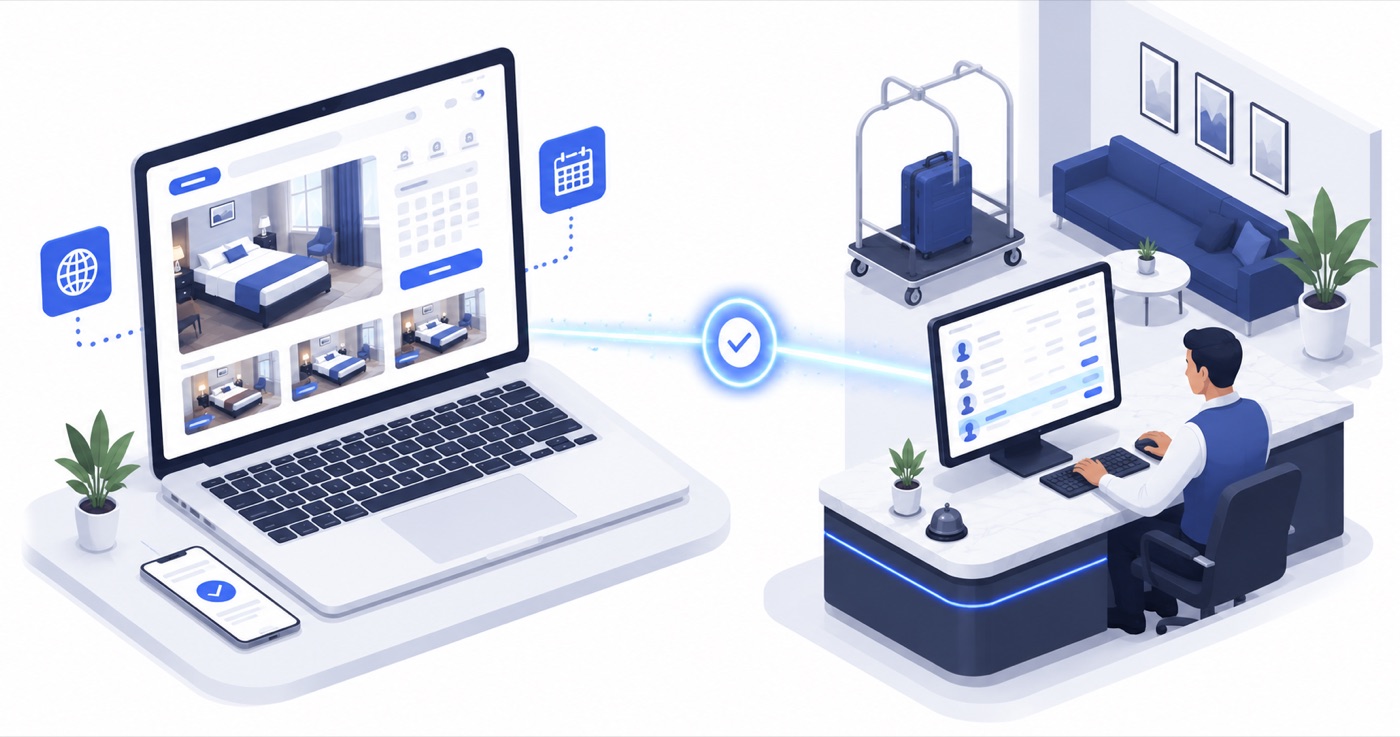
Table of Contents
The hidden cost of disconnected systems
In an era where digital commission costs consume between **15% and 25% of gross room revenue**, independent hoteliers have aggressively invested in custom websites, commission-free booking engines, and digital marketing. The goal is straightforward: bypass Online Travel Agencies (OTAs) like Booking.com, Agoda, and MakeMyTrip, and own the guest relationship directly.
However, a major operational flaw plagues thousands of hotel properties: **their direct booking engine is completely disconnected from their front-desk Property Management System (PMS)**.
When a guest books a room on a standalone booking website, the reservation lands as an isolated email or third-party dashboard notification. The front desk staff must then manually re-type the reservation details, guest name, contact phone, check-in dates, and payment status into their operational PMS calendar.
This manual bridge is an invisible revenue killer. Far from saving money, hotels running disconnected booking engines simply exchange OTA commission fees for operational friction, double-booking risks, delayed confirmations, and severe guest dissatisfaction.
---
The Four Major Failure Points of Disconnected Booking Engines
```
[Guest Books on Direct Website]
│
▼ (Email / Disconnected Portal Notification)
[Front Desk Busy with Check-Ins]
│
▼ (Manual Re-Keying Lag: 15 mins to 4 hours)
[Human Typing Error or Inventory Oversold on OTAs]
│
▼
[Double-Booking Conflict / Frustrated Guest at Arrival]
```
1. Manual Double-Entry & Human Errors
During peak booking hours, front-desk receptionists are multi-tasking: handling walk-ins, checking out departing guests, answering phone calls, and managing room keys. When a direct website reservation email arrives, it often sits unread for 30 minutes to several hours.
When the receptionist finally gets around to entering the booking manually, human errors inevitably occur:
2. The Overbooking Nightmare During Peak Demand
When your website inventory is not synchronized in real-time with your front desk and OTA channel manager, double bookings are mathematically guaranteed to occur during high-demand dates (holidays, long weekends, festival seasons).
Imagine a scenario where your property has exactly 1 Deluxe Room remaining for Friday night:
When the online guest arrives on Friday evening expecting a confirmed room, the hotel is forced to "walk" the guest to a competitor property—paying out-of-pocket transportation costs, refunding the booking, and absorbing a damaging 1-star review.
3. Defensive Inventory Throttling
To avoid the overbooking scenario described above, hoteliers using disconnected systems resort to a self-defeating tactic: **inventory throttling**.
Instead of listing 100% of their available rooms on their direct website, they artificially cap the website inventory—allocating only 2 or 3 rooms online and keeping the rest offline. This artificial bottleneck severely restricts direct sales, forcing eager guests to book via OTAs where full inventory is listed, thereby handing 18% commission back to the OTA!
4. Pricing & Rate Parity Discrepancies
Updating room rates dynamically across a disconnected ecosystem is an administrative nightmare. If a hotel owner decides to increase rates for an upcoming long weekend, they must manually update:
Inevitably, rates become desynchronized. Guests discover that your direct website is charging ₹5,500 while an OTA lists the same room for ₹4,800. Expecting the lowest price on the direct channel, the guest loses trust and completes their booking on the OTA.
---
Direct Booking Financial Math: Commission Savings Analysis
To evaluate the financial return of a fully integrated PMS and Direct Booking Engine, consider the annual financial metrics of an independent 35-room hotel in India:
Property Operating Profile
| Booking Channel Split | Room Nights | Gross Revenue | Commission Rate | Annual Commission Paid |
| :--- | :--- | :--- | :--- | :--- |
| **OTAs (Booking/Agoda/MMT)** | 70% (6,260 nights) | ₹2,62,92,000 | 18% | **₹47,32,560** |
| **Walk-Ins & Phone** | 20% (1,788 nights) | ₹75,11,280 | 0% | ₹0 |
| **Direct Website (Disconnected)** | 10% (894 nights) | ₹37,55,120 | 0% | ₹0 |
The Integration Impact (Shifting 25% OTA Volume to Integrated Direct Website)
If the property connects its direct website booking engine seamlessly to its front-desk PMS—offering instant confirmation, live inventory sync, and direct-only perks (such as free breakfast or flexible checkout)—it can realistically shift 25% of its OTA bookings to the direct channel.
By eliminating manual re-keying and enabling real-time booking confirmation, the hotel retains nearly **₹12 Lakhs in net profit** every year without increasing its marketing budget or building extra rooms.
---
How Real-Time Front-Desk Integration Works in Antena
Antena’s unified architecture eliminates the gap between the public website and the front-desk operations by running both on a **single, unified cloud database**.
```
[Unified Antena Cloud Engine]
│
┌────────────────────────────┼────────────────────────────┐
▼ ▼ ▼
[Direct Booking Engine] [Front-Desk Tape Chart] [OTA Channel Manager]
(Instant Lock & Pay) (Live Room Assignment) (Real-Time Inventory)
```
1. Zero-Lag Reservation Creation
When a guest selects dates and pays on your Antena-powered website, the system executes an atomic transaction. The booking is instantly created in the core database, allocating the room on the front-desk tape chart in under 500 milliseconds.
2. Automatic Customer CRM Resolution
The system checks incoming guest details against your historical CRM database. If the guest has stayed at your property before, their profile, preferences, and billing history are automatically linked to the new reservation.
3. Automated Instant Confirmation & WhatsApp Alerts
The moment payment is processed, the guest receives a branded confirmation via email and WhatsApp containing their reservation code, directions, check-in instructions, and pre-arrival registration link.
4. Dynamic Parity Control & Direct Perks
Because rates and rate plans are defined once in the central system, rate updates instantly propagate to the direct booking engine. Hotels can configure direct-only rate plans—such as *"Direct Booking Special: Includes Complimentary Breakfast & Late Check-out"*—without violating standard rate parity rules.
---
Frequently Asked Questions (FAQ)
Q1: What is Rate Parity, and will OTAs penalize my hotel if I offer lower rates on my website?
Rate Parity is a legal clause in OTA contracts requiring hotels to maintain the same base room rate across all public sales channels. However, hotels can easily offer superior value on their direct website without violating parity by bundling exclusive perks—such as free airport transfers, complimentary breakfast, early check-in, or food-and-beverage vouchers—that are not available on OTAs.
Q2: How does an integrated booking engine handle online advance payments?
An integrated platform like Antena connects directly with payment gateways (such as Cashfree, Razorpay, or Stripe). When a guest pays an advance deposit online, the funds land in your gateway account, and the payment is automatically posted as a credit entry on the guest’s folio in the front-desk PMS.
Q3: Does our front desk still need to approve online website bookings?
No. In an integrated architecture, website bookings are auto-confirmed against real-time room availability. However, front-desk staff retain full control to adjust room numbers, assign specific floor preferences, or process upgrades prior to arrival.
---
Conclusion
A direct booking website is only as powerful as its operational connection to your front desk. Disconnected booking engines cost hoteliers thousands of Rupees in wasted labor, double-booking errors, and lost direct volume. By unifying your public booking website with your front-desk PMS, your hotel can deliver the instant confirmation modern guests demand while keeping high-margin commission savings where they belong: in your bank account.
Traditional PMS vs Modern Cloud OS
| Feature | Traditional PMS | Modern Cloud OS |
|---|---|---|
| Mobile Access for Staff | Rarely included, or very clunky | Native Mobile/PWA standard |
| Restaurant POS Sync | Requires 3rd-party integration | Built-in and synced instantly |
| Direct Booking Engine | Paid extra add-on | Included out of the box |
| Multi-Property Management | Requires VPNs or complex setups | Switch properties in one click |
| Pricing Model | Hidden pricing, long contracts | Transparent flat monthly fee |
About Anika Dhingra
Founder
Anika is a founder of Antena. She pairs a technical background with a strong interest in the technology and guest-facing side of hospitality — booking flows, automation, and the numbers that tell an owner what is actually working. She writes about using technology to take friction out of the guest experience and the teams behind it, without piling on complexity.
Related Articles
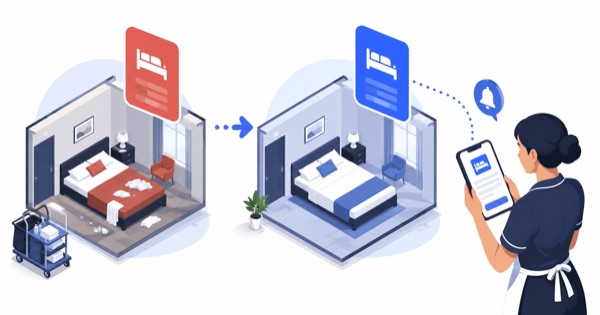
Why Every Hotel Should Automate Housekeeping Assignment After Guest Checkout
Housekeeping delays are a leading cause of late room readiness and guest complaints. Discover how automating housekeeping assignments after checkout transforms hotel operations.
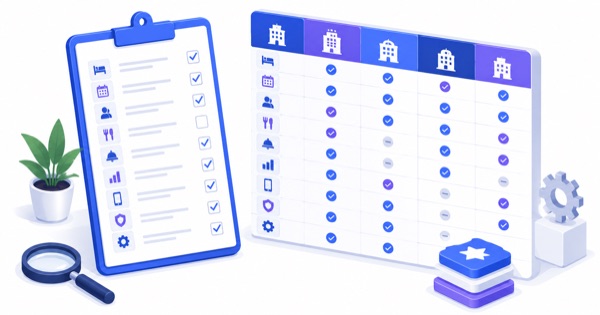
How to Choose Hotel Management Software in 2026
The hospitality industry is shifting from legacy, on-premise servers to modern, unified cloud platforms. Here is what you need to look for when upgrading your hotel PMS.
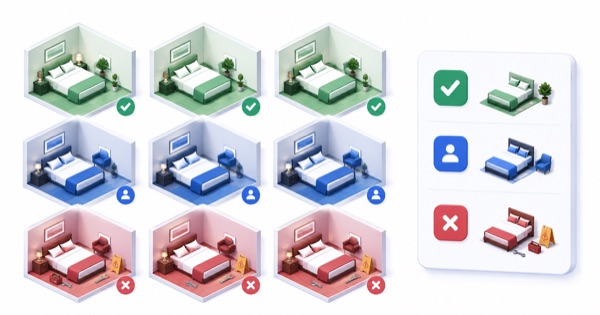
Hotel Room Status Codes Every Front Desk Should Know
VC, VD, OOO, DND — the short codes that pass a room between housekeeping and the front desk. Here is what each one means and why getting them right protects your revenue.