How Front-Desk Upselling Works (Without Being Pushy)
Check-in is the most underused revenue moment in an independent hotel. Done well, upselling raises revenue and guest satisfaction at the same time — here is how.
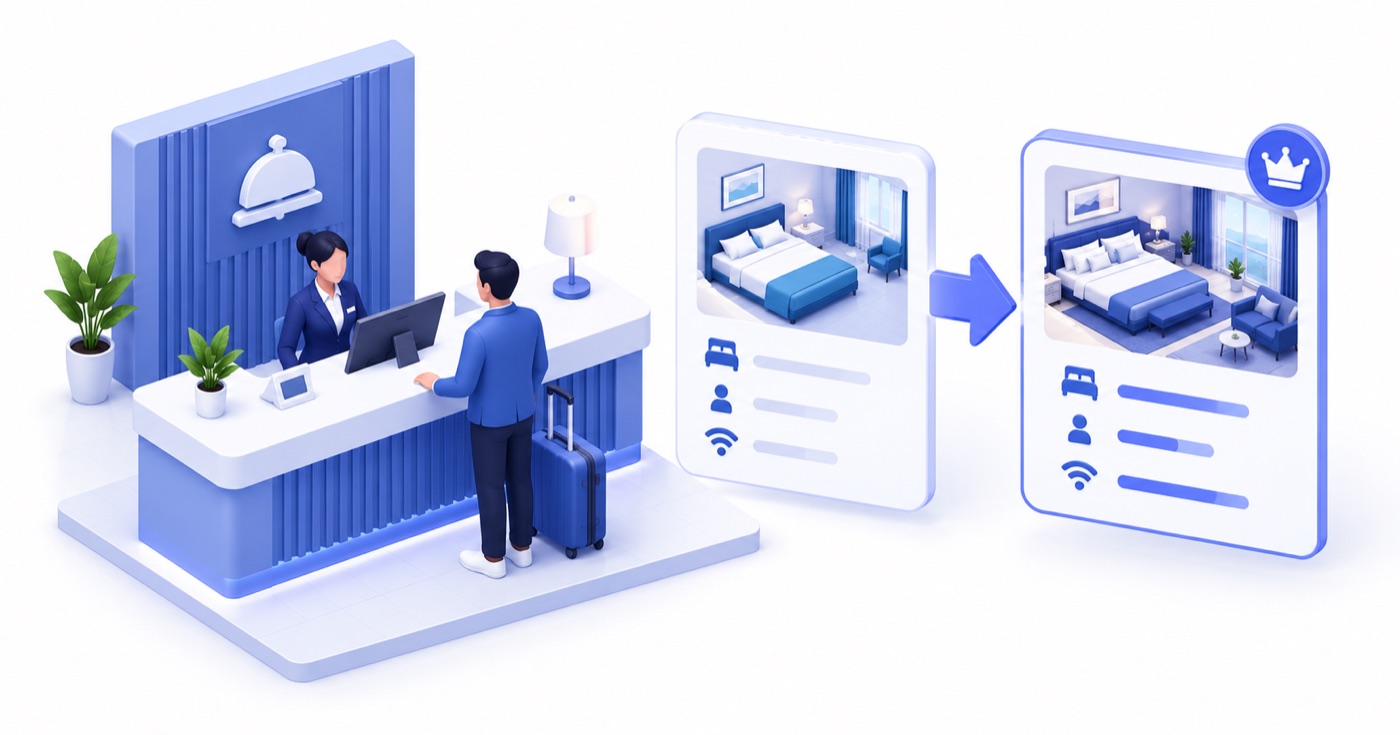
Table of Contents
The Untapped Checking-In Revenue Opportunity
In most independent hotels, check-in is treated as a purely administrative transaction: verify ID, swipe card, issue keycard, point toward the elevator.
However, the moment a traveler arrives at your front desk, they enter their highest intent window. They have completed their travel journey, arrived at your property, and are physically standing in front of your front-desk team. This makes check-in the single highest-margin revenue conversion point in the hotel lifecycle.
Front-desk upselling is not about aggressive sales tactics or tricking guests into unwanted expenses. Done professionally, **upselling is value matching**—identifying a guest's unstated travel needs (extra space, early access, premium view, breakfast convenience) and presenting a high-value upgrade option at a fraction of standard retail cost.
---
The 4 Primary Front-Desk Upsell Categories
```
[Front-Desk Upsell Categories]
├── 1. Physical Room Category Upgrades (Deluxe ➔ Executive Suite / Balcony View)
├── 2. Timing Flexibilities (Guaranteed Early Check-in / Extended Late Check-out)
├── 3. F&B Bundling (Discounted Breakfast Buffet / Dining Vouchers)
└── 4. Special Occasion Packages (Anniversary Wine, Spa Slot, Airport Shuttle)
```
---
Front-Desk Upselling Scripting Matrix & Framing Techniques
How an offer is phrased by a receptionist dictates whether a guest feels valued or pressured. Below is an operational matrix of proven framing techniques:
| Upsell Type | Poor / Pushy Scripting | Professional Value-Framing Script | Conversion Rate |
| :--- | :--- | :--- | :--- |
| **Room Upgrade** | *"Would you like to pay ₹2,000 more to upgrade to our Suite?"* | *"Mr. Sharma, I see you are staying with us for 3 nights on business. We have an Executive Suite available on our top floor with a private work desk and mountain view. Since you are already checked in, I can offer that upgrade for just ₹1,200 per night."* | **28% – 35%** |
| **Early Check-In**| *"Check-in is at 2:00 PM. You're 3 hours early so you must wait."* | *"Welcome Mr. Verma! Your room will be ready at 2:00 PM. However, if you'd like immediate access right now to shower and refresh, we can activate our Early Check-In pass for just ₹600."* | **42% – 50%** |
| **Breakfast Bundle**| *"Do you want to add breakfast for ₹500?"* | *"Our morning buffet features live dosa and omelet stations at ₹600 tomorrow. If we add it to your folio right now at check-in, it is bundled at just ₹350 per person."* | **38% – 45%** |
| **Late Check-Out** | *"Checkout is strictly 11:00 AM or we charge a penalty."* | *"Ms. Kapoor, if your flight tomorrow evening is late, we can extend your room access until 4:00 PM for ₹900 so you don't have to wait at the airport."* | **30% – 38%** |
---
Financial Impact: The Pure Profit Margin of Upselling
Because the base operational cost of the room (linen, electricity, front-desk staffing) is **already paid for** by the guest's base reservation, incremental upsell revenue carries a **90%+ net profit margin**.
Scenario: 35-Room Boutique Hotel (30 Check-Ins Daily)
---
Staff Incentive Models: Aligning Front-Desk Motivation
To build a high-performing front-desk team, hoteliers must share a portion of the upsell margin directly with the reception agent who closed the conversion:
---
Frequently Asked Questions (FAQ)
Q1: How does an agent know which upgrade rooms are open without overselling?
Reception agents need real-time tape chart visibility. In Antena, available room category upgrades for tonight are highlighted directly on the agent's check-in screen, preventing double-booking or offering rooms reserved for late-arriving guests.
Q2: What is the golden rule when a guest declines an upsell offer?
Accept the response graciously with zero hesitation. The agent should immediately pivot back to standard check-in: *"No problem at all, Mr. Gupta! Your Deluxe Room on the 3rd floor is wonderful. Here is your keycard."*
Q3: Should front desk agents upsell guests who booked through OTAs like Booking.com or Agoda?
Yes! OTA guests are the best candidates for front-desk upselling. Since OTAs take 18% commission on the base room rate, any on-site upsell collected directly at the front desk carries **0% OTA commission**, allowing the hotel to capture 100% of the incremental upgrade value.
About Soumya Srivastava
Founder
Soumya is the founder of Antena. A close interest in the day-to-day realities of running hotels and restaurants, paired with a technical background, shapes how she approaches hospitality software — starting from the operational problem rather than the feature list. She writes about the business thinking behind smoother front-desk, housekeeping, and F&B operations.
Related Articles
Why Every Hotel Should Automate Housekeeping Assignment After Guest Checkout
Housekeeping delays are a leading cause of late room readiness and guest complaints. Discover how automating housekeeping assignments after checkout transforms hotel operations.
Why Hotels Lose Revenue When Their Direct Booking Website Isn't Connected to Front Desk Operations
Many independent hotels invest in a beautiful booking website but still manage reservations manually. This disconnect leads to overbookings, delayed confirmations, and pricing inconsistencies.
How Role-Based Access and Quick PINs Keep Your Front Desk Secure and Fast
Antena separates who can log into your dashboard from who can work a shift on the floor — here is why that split matters, and how Quick PINs make shift handoffs fast without weakening security.