RevPAR, ADR, and Occupancy: The Three Hotel Metrics That Actually Matter
Occupancy tells you how full you are, ADR how much you charge, and RevPAR ties them together. Here is how each is calculated and what it actually tells you about your hotel.

Table of Contents
The Core Triad of Hotel Revenue Performance
Independent hoteliers are inundated with operational metrics every single day. However, when evaluating the financial health and yield performance of a rooms division, three core Key Performance Indicators (KPIs) provide 90% of the true operational signal:
Relying on any single metric in isolation is dangerous. A property can boast 98% occupancy while operating at a net loss due to severe room rate discounting. Conversely, a hotel can achieve a high ADR of ₹9,000 but languish at 25% occupancy, failing to generate enough total cash flow to cover fixed overhead.
```
┌───────────────────────────────┐
│ Occupancy Rate (%) │
│ (Volume / Asset Utilization) │
└───────────────┬───────────────┘
│
▼
┌───────────────────────────────┐ │ ┌───────────────────────────────┐
│ Average Daily Rate (ADR) │───┼──►│ RevPAR (Rev Per Available) │
│ (Price / Yield Realized) │ │ │ (The Definitive Core Metric) │
└───────────────────────────────┘ │ └───────────────────────────────┘
▼
┌───────────────────────────────┐
│ GOPPAR (Net Operating) │
│ (Gross Operating Profit/Room) │
└───────────────────────────────┘
```
---
1. Occupancy Rate: Formula, Calculation & Pitfalls
Occupancy measures the percentage of available rooms occupied by paying guests during a specified period (daily, monthly, or annually).
The Mathematical Formula:
$$ ext{Occupancy Rate (%)} = left( rac{ ext{Total Rooms Sold}}{ ext{Total Available Sellable Rooms}} ight) imes 100$$
Practical Example:
A boutique hotel has 40 total keys. On Friday night, 32 rooms are checked in with paying guests, 6 rooms sit vacant, and 2 rooms are out of service for bathroom remodeling.
$$ ext{Available Rooms} = 40 - 2 ext{ (OOO)} = 38 ext{ Keys}$$
$$ ext{Occupancy Rate} = left( rac{32}{38} ight) imes 100 = mathbf{84.21%}$$
[!IMPORTANT]
**The Denominator Trap:** Always subtract **Out of Order (OOO)** rooms from total property inventory. Including OOO rooms artificially deflates your true operational occupancy score.
---
2. Average Daily Rate (ADR): Formula & Pricing Dynamics
Average Daily Rate measures the average rental revenue earned per **sold** room. It reflects your pricing structure, channel distribution mix, and guest segment breakdown.
The Mathematical Formula:
$$ ext{ADR} = rac{ ext{Total Gross Room Revenue}}{ ext{Total Rooms Sold}}$$
Practical Example:
Using the same Friday night scenario, the 32 sold rooms generated ₹1,68,000 in total gross room revenue (excluding restaurant sales, laundry, and taxes).
$$ ext{ADR} = rac{ ext{₹1,68,000}}{32} = mathbf{₹5,250}$$
Note that ADR only accounts for rooms that were **actually sold**. It provides zero visibility into the cash lost on unsold inventory sitting vacant.
---
3. RevPAR: The Master Benchmark
Revenue Per Available Room blends occupancy volume and ADR pricing into a unified index. It is impossible to inflate RevPAR artificially without improving the underlying economic balance of your hotel.
The Two Mathematical Methods:
$$ ext{Method 1: RevPAR} = rac{ ext{Total Gross Room Revenue}}{ ext{Total Available Sellable Rooms}}$$
$$ ext{Method 2: RevPAR} = ext{ADR} imes ext{Occupancy Rate (as a decimal)}$$
Practical Example:
$$ ext{Method 1: RevPAR} = rac{ ext{₹1,68,000}}{38} = mathbf{₹4,421.05}$$
$$ ext{Method 2: RevPAR} = ext{₹5,250} imes 0.8421 = mathbf{₹4,421.02}$$
---
Scenario Analysis Matrix: Evaluating Revenue Strategies
Below is a comparison of three distinct 50-room hotels operating on the same night in the same city:
| Property Profile | Available Keys | Rooms Sold | Gross Room Rev | Occupancy | ADR | RevPAR | Financial Assessment |
| :--- | :--- | :--- | :--- | :--- | :--- | :--- | :--- |
| **Hotel A (Discounting)** | 50 Keys | 48 | ₹1,44,000 | **96.0%** | ₹3,000 | ₹2,880 | High wear & tear, high laundry cost, low net margin. |
| **Hotel B (High Rate)** | 50 Keys | 20 | ₹1,60,000 | **40.0%** | ₹8,000 | ₹3,200 | Low staff strain, but high uncaptured market demand. |
| **Hotel C (Balanced OS)** | 50 Keys | 38 | ₹2,09,000 | **76.0%** | ₹5,500 | **₹4,180** | **Optimal strategy:** Highest total cash flow & RevPAR. |
---
Beyond RevPAR: Introducing GOPPAR (Gross Operating Profit Per Available Room)
While RevPAR is essential, modern hoteliers must also evaluate bottom-line profitability using **GOPPAR**:
$$ ext{GOPPAR} = rac{ ext{Gross Operating Profit (Gross Revenue - Operating Expenses)}}{ ext{Total Available Sellable Rooms}}$$
GOPPAR accounts for OTA commission costs, labor expenses, energy costs, and amenities. A direct website booking at a ₹4,500 rate yields a higher GOPPAR than a ₹5,000 booking sourced through an OTA charging 22% commission!
---
Frequently Asked Questions (FAQ)
Q1: Should complimentary or house-use rooms be included in the ADR calculation?
No. Free promotional stays, staff house-use rooms, or complimentary manager stays should be excluded from "Rooms Sold" when calculating commercial ADR. Including unpaid zero-rate rooms artificially depresses your ADR.
Q2: How can an independent hotel increase RevPAR without dropping rates?
Hoteliers can boost RevPAR by unbundling premium amenities (offering early check-in, late check-out, or balcony room upgrades at check-in), converting OTA traffic to direct website bookings (eliminating 18% commission fees), and setting dynamic minimum-length-of-stay (MLOS) controls during peak event weekends.
Q3: How often should hotel management review RevPAR performance?
RevPAR should be calculated daily on your PMS tape chart and reviewed in detail during weekly management meetings to adjust dynamic pricing tariffs across OTAs and your direct booking engine.
About Soumya Srivastava
Founder
Soumya is the founder of Antena. A close interest in the day-to-day realities of running hotels and restaurants, paired with a technical background, shapes how she approaches hospitality software — starting from the operational problem rather than the feature list. She writes about the business thinking behind smoother front-desk, housekeeping, and F&B operations.
Related Articles

Why Hotels Lose Revenue When Their Direct Booking Website Isn't Connected to Front Desk Operations
Many independent hotels invest in a beautiful booking website but still manage reservations manually. This disconnect leads to overbookings, delayed confirmations, and pricing inconsistencies.
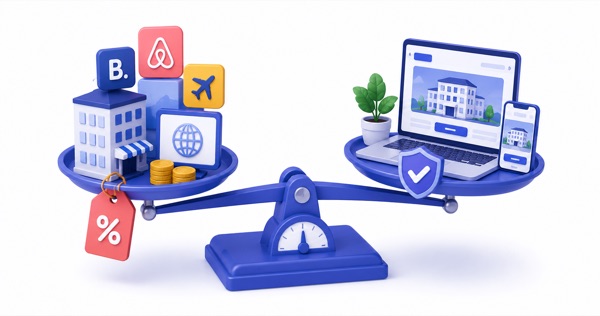
OTA vs Direct Booking: The Real Trade-offs for Independent Hotels
Online travel agents bring reach; direct bookings keep the margin and the guest relationship. The smart play is not choosing one — it is using each for what it does best.
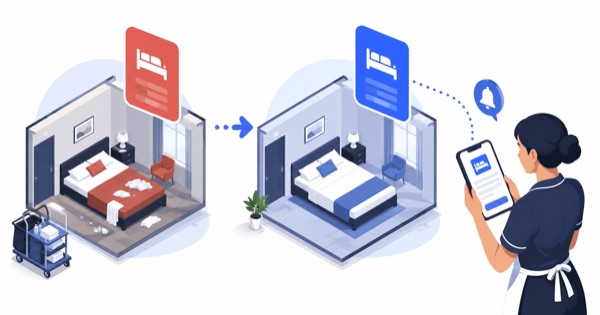
Why Every Hotel Should Automate Housekeeping Assignment After Guest Checkout
Housekeeping delays are a leading cause of late room readiness and guest complaints. Discover how automating housekeeping assignments after checkout transforms hotel operations.